What was announced
On October 20, Believe said it signed a licensing agreement with Spotify for the tool Spotify is building for AI-powered covers and remixes. It covers participating artists and labels at Believe and its self-release arm TuneCore.
- The line-up so far: Universal Music Group (May), Merlin (August 4), Kobalt (August 13), now Believe. Sony Music and Warner Music have not announced deals.
- What it is: described as built for AI remixes and covers, "not entirely new works" — and designed as a paid add-on for Premium subscribers. Every remix links back to the original track and artist.
- Opt-in: participation is voluntary. Believe uses a two-step consent flow: artists first choose whether they want to be considered for AI programs at all, then decide on Spotify specifically.
- Money: participating artists and the rights holders behind the original songs are to be paid when remixes are streamed. No royalty rates, price or launch date have been published.
The good part: consent first
I have spent months writing about AI music that was taken — scraped audio, fake streams, takedown lotteries. I covered it in the week AI music got the bill. This is the opposite model: a licence, an opt-in, a payment line. Whatever you think of AI, "ask first, pay after" is the only version of this I can respect.
Remixing is also how my own catalogue exists — the 2Pac × Deep House series is a conversation with a voice that changed me. A remix is homage and arrangement, not a shortcut. A button that lets anyone generate one in seconds is a different thing, and I want to see it done properly.
«A remix is a conversation. If one side never agreed to speak, it is not a conversation.» — Murat Koff
The questions nobody has answered yet
- Who earns what? The reports say artists and original rights holders get royalties. They do not say whether the fan who makes the remix earns anything, or what the split is.
- Who is missing? With two majors silent, whole catalogues may simply not be remixable. The Spotify co-CEO said in August that it does not need a deal with every major to launch.
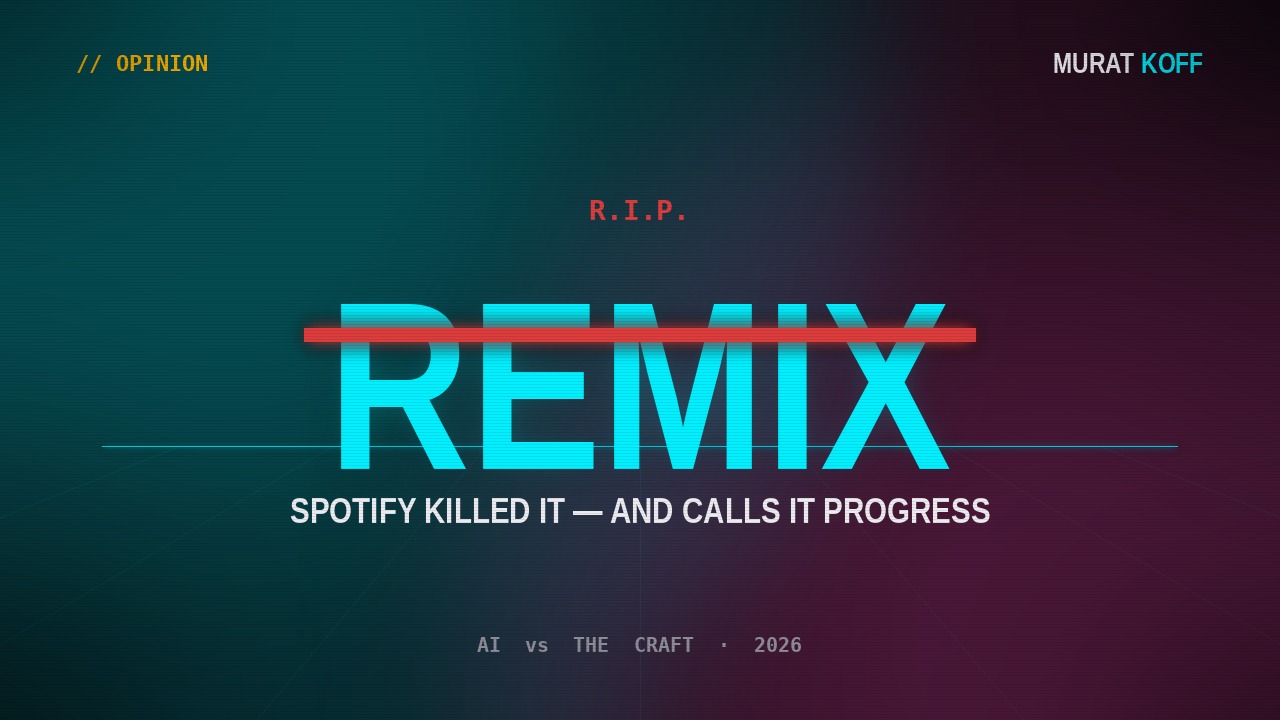
- Where does the remix live? Inside a paid Premium add-on. The listener-made version stays on the platform; the platform sets the rules. I argued exactly that in Spotify killed the remix, and I still think the tenant-versus-landlord problem is the real story.
What I do with this
Nothing changes in the studio. I still start from a voice, a key and a late-night drive. What changes is how I think about distribution: if the biggest platform is going to sell a remix button, then the places where people choose my version on purpose — my channel, my releases, my own website — matter more, not less.
A page that sells what you make.
One of the 7 lessons in my course covers a simple, honest product page with a payment-link button — your site just holds the button. 25 $, no code, in English. No promises about traffic or sales; it is the method I used for this site, which I built with AI tools as my developer. The music stays human.
See the 7 lessons →For the next drop, the plan is the same as always: new music every Tuesday and Thursday, and a deep house record you can find in one place that no licensing negotiation can switch off.